More money for Banks as BoE keeps interest rates at 0.5%

AGENCE FRANCE PRESSE | APRIL 18, 2012

Bank of England policymakers all voted in favour of holding interest rates at a record low earlier in April, while one member called for more stimulus cash, the BoE said on Wednesday.

Minutes from the central bank’s Monetary Policy Committee (MPC) meeting on April 4-5 showed that the nine policymakers voted to keep the key lending rate at 0.50 percent, where it has stood since March 2009.

The policymaking panel meanwhile voted 8-1 at the same meeting in favour of maintaining the size of the bank’s asset purchasing programme at £325 billion (388 billion euros, $514 billion).

One member, David Miles, voted for the second month to increase the so-called quantitative easing (QE) programme by an additional £25 billion.

Under QE, the central bank creates new cash that is used to purchase assets such as government and corporate bonds in the aim of giving a boost to lending and economic activity.

“For most members, there was no sufficient reason to change either bank rate or the quantity of asset purchases,” the minutes read.

“Moreover, for them, it seemed sensible to let the current programme of asset purchases run its course while coming to a view on medium-term prospects in the context of the May forecast round.

“For one member, the balance of risks continued to warrant an expansion of the asset purchase programme this month, although the decision was finely balanced.”

European Central Bank acts to prop up debt of Italy, Spain

By Anthony Faiola
Washington Post
August 8, 2011

LONDON—Moving to stem panic of an escalating debt crisis in Europe, the European Central Bank on Sunday signaled it would intervene in bond markets to prop up hard-hit Italy and Spain, as world leaders scrambled to calm investors before the opening of financial markets Monday.

The reluctant decision by the ECB underscored the gravity of a crisis that some fear could lead to a messy breakup of the euro zone if not quickly contained, and which has gathered fresh urgency following the downgrading of U.S. debt by Standard & Poors.

Worried investors have been dumping Italian and Spanish bonds, driving their borrowing costs to record levels in recent days and sparking fears the world’s 7th and 12th largest economies could be engulfed by the same kind of crisis that forced far smaller Greece, Ireland and Portugal to request emergency bailouts. By intervening in bond markets, however, the bank could at least temporarily take some of the pressure off both nations by buying debt that private investors now see as too risky.

The ECB, as is customary, did not explicitly say it would buy Italian and Spanish bonds. But it strongly suggested in a statement that it would do so, with its move amounting to an admission that the bank’s tepid dabbling in bond markets last week did not go nearly far enough in calming investors. The bank’s governing council agreed after an 11th-hour emergency teleconference on Italy and Spain to take more drastic steps “to ensure [bond] price stability in the euro area.”

The move came as European leaders Sunday were scrambling to calm investors jittery over the crushing debt of wealthy nations. Without further steps from governments and central bankers, analysts fear more drops in global stock markets – with bourses in the Middle East, open on Sunday, tumbling ahead of the opening of key Asian trading.

A European official who declined to be named given the sensitivity of the issue said “a range of international discussions” was coming together Sunday. Those talks were set to include conference calls between G7 financial chiefs.

German Chancellor Angela Merkel and French President Nicholas Sarkozy issued a joint statement backing moves by Rome and Madrid on Friday to speed up austerity measures and adopt reforms to improve stagnant growth.

Opposition in fiscally conservative Germany, by far the largest economy in the 17-nation euro zone, to intervention by the ECB was seen as one major factor holding the bank back. But the ECB, in the text of its statement Sunday, appeared to interpret Merkel’s joint statement with Sarkozy as a sign of grudging acceptance from Berlin that more must be done.

With concern increasingly centered on Italy, whose debt amounts to a whopping 119 percent of its national economy, Merkel and Sarkozy “especially” welcomed the announcement by Italian Prime Minister Silvio Berlusconi “to achieve a balanced budget a year earlier than previously envisaged.”

Raj Badiani, an economist with IHS Global Insight in London, called the ECB move “an attempt to provide a sharp jolt to the negative sentiment engulfing Spain and Italy.”

But he and others warned it may only be a short-term solution. The ECB cannot indefinitely intervene in European bond markets on such a grand scale. A program that goes on too long could trigger inflation and undermine the stability of the euro. Rather, the ECB may effectively be buying time for European leaders to do something they have thus far failed to do — take decisive action to end the crisis.

Analysts have been calling for European leaders to greatly expand a bailout fund to cover a worst-case scenario in Italy and Spain. But European leaders were doggedly sticking to a July 21 agreement that once again shored up Greece while also allowing rescue funds to be used to buy up the bonds of troubled nations in times of crisis, much like the ECB.

But the pool of cash available, about $616 billion, does not approach the level needed to aid Italy or Spain, and European leaders have showed no signs of agreement in raising that amount. In addition, all 17 nations in the euro zone still need to ratify that deal before it can go into effect.

Europe, led by Germany, has bailed out Greece, Ireland and Portugal. But German voters have had it with bailouts, and in a worst-case scenario Italy would need roughly $1.4 trillion — or more than double the size of the current European rescue fund.

Rather, Europeans leaders and the ECB seem to be banking on temporary intervention to give Italy and Spain time to make good on their pledges to restore market confidence through budget cuts and long-awaited economic reforms.

“I suspect it could help to stabilize Italian bond yields at current levels, and help to deflect some of the financial contagion hitting Italy,” Badiani said. “However, we will need to see much more detail about the scale of the proposals and the pace of implementation before there is any significant unwinding of the bond yield rises of the past month.”

If Italy or Spain fails to quell market panic, analysts say, Europeans might be forced to move toward the advent of a new euro-bond, putting the economic weight of Germany behind its profligate neighbors. But Germany and other northern European nations remain opposed to such a deal, as well as the more radical step of a more established fiscal union that would go further in turning a vast chunk of Europe into one giant economy.

No Bank Tax in Second Greek Deal

Reuters
July 21, 2011

Germany and France have ruled out a bank tax after reaching a common position on a second bailout of Greece to prevent the country’s debt crisis spreading through Europe, EU sources said on Thursday.

The accord came after seven hours of talks late into Wednesday night between German Chancellor Angela Merkel and French President Nicolas Sarkozy in Berlin, sources in both governments said.

European Central Bank President Jean-Claude Trichet joined Merkel and Sarkozy for part of their talks and one source said their agreement, kept secret to avoid offending other euro group leaders at a summit on Thursday, had his blessing.

“You should assume that there will not be a banking tax,” the source told Reuters.

Another source involved in preparatory talks for the emergency summit of the 17-nation currency area confirmed that the banking tax proposal, raised last week, had been dropped.

While few details of the Franco-German deal emerged, the sources said it would include private sector involvement that should not cause either a default or selective default of Greek debt, a red line for the ECB.

The risk premium investors demand to hold peripheral euro zone government bonds rather than benchmark German Bunds fell on Thursday on news of the Franco-German agreement.

“There are huge expectations something will be done… the big disappointment could come from how quickly they can implement things. They can agree principles but implementation will take a long while,” said Peter Schaffrik, a strategist at RBC Capital Markets.

The 115 billion euro second Greek rescue package would involve both more official funding from the euro zone rescue fund and the IMF and a contribution by private sector bondholders on which two senior bankers will make a presentation to leaders on Thursday, the sources said.

Baudoin Prot of BNP Paribas, the French bank with the biggest exposure to Greek debt, and Deutsche Bank chief executive Josef Ackermann, chairman of the International Institute of Finance, a banking lobby that has led talks among bankers, will attend, banking sources said.

The leaders are due to meet at 1100 GMT but the start could well be delayed as euro zone sherpas work to thrash out details of an agreement, officials said.

The aim is to make Greece’s debt more sustainable and prevent fears of a disorderly default from poisoning access to the bond market for bigger states such as Italy and Spain.

Read Full Article…

U.S., Europe to keep data on travelers for 15 years

Guardian
May 25, 2011

The personal data of millions of passengers who fly between the US and Europe, including credit card details, phone numbers and home addresses, may be stored by the US department of homeland security for 15 years, according to a draft agreement between Washington and Brussels leaked to the Guardian.

The “restricted” draft, which emerged from negotiations between the US and EU, opens the way for passenger data provided to airlines on check-in to be analysed by US automated data-mining and profiling programmes in the name of fighting terrorism, crime and illegal migration. The Americans want to require airlines to supply passenger lists as near complete as possible 96 hours before takeoff, so names can be checked against terrorist and immigration watchlists.

The agreement acknowledges that there will be occasions when people are delayed or prevented from flying because they are wrongly identified as a threat, and gives them the right to petition for judicial review in the US federal court. It also outlines procedures in the event of anticipated data losses or other unauthorised disclosure. The text includes provisions under which “sensitive personal data” – such as ethnic origin, political opinions, and details of health or sex life – can be used in exceptional circumstances where an individual’s life could be imperilled.

The 15-year retention period is likely to prove highly controversial as it is three times the five years allowed for in the EU’s PNR (passenger name record) regime to cover flights into, out of and within Europe. A period of five and a half years has just been negotiated in a similar agreement with Australia. Germany and France raised concerns this week about the agreement and the unproven necessity for the measure.

Britain has already announced its intention to opt in to the European PNR plan, in which the home secretary, Theresa May, played a key role, and is expected to join the US agreement this summer.

The Home Office minister Damian Green has said: “The power of PNR lies in the fact that by using an automated system and interrogating it intelligently, we are able to sift data quickly and in such a way that it reveals patterns and makes links that would otherwise not be readily apparent.”  Read Full Article…

Swarm of protests re-ignite in Spain

By Gregory White
Business Insider
May 20, 2011

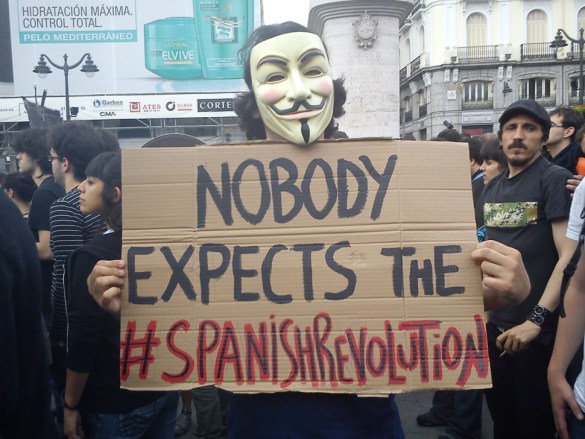
Protests have been raging in Spain since Sunday, May 15. The one we’ve been seeing pictures of is in Madrid, in the famous Puerta del Sol. But there were protests in 60 different locationson Sunday, and they’re still raging in different parts of the country.

The center of the movement is very much Puerta del Sol, where protesters are now camping out overnight just like they did in Tahrir Square in Egypt. The protesters claim they will stay in the square until after regional elections this Sunday, according to Der Spiegel. The protest movement has been declared illegal by the government, over fears it may influence the result of the elections. The traditional media is allegedly under-covering the story.

Protesters aren’t associated with any political party in particular and, instead, the movement is serving as a catch all for those upset over the current economic situation in Spain. The country has a 21% unemployment rate and a 43% youth unemployment rate. Its inflation rate is above the eurozone average and its growth remains low.

From the outside looking in, it resembles the situation in Egypt in many ways. Disaffected youth, enraged by a high unemployment rate, communicating over new forms of social media, subverting the traditional power structure in the country.

But Spain is a completely different country than Egypt, and others experiencing protest movements in the Middle East. It’s democratic, and protesters are requesting reforms, not regicide. And things are getting better in Spain, although perhaps not fast enough.

In many ways, it comes down to what happens at this weekend’s elections, according to Pau Garcia:

If the upcoming elections see a raise in the number of voters, but a decline in the two biggest political parties (Out own republican and democrat parties) , the social movement will go further, and probably some key changes will start to evolve.  But if less people vote, or in uncertainty the fear moves people to the biggest parties, as strong as the tide arrived, it will go back to the traditional and sadly famous Spanish lack of interest on anything beyond food, R&R and soccer.

So you need to watch the protests closely, especially in the wake of Sunday’s elections.